
How it works
Welcome!
This page tells you everything you need to know about using Skillcards in your reward and consent based horse training.
This way of structuring your goals is designed to help you actually apply all the theory you’ve read or heard about for years; easily, practically, and with real, frequent and sustainable results.
With a goal, a plan, an example, a clear next step and a tangible Skillcard to earn, you’ll be itching to get back in the training game.
Contents of this page
If you want, you can skip to:
Skillcards give you instantly get clarity on:
-
What you and your horse already know
-
What you are going to practise next
- Where to begin with a new training challenge
- What exercises your bigger goals consist of
- What a strong, robust and reliable foundation entails
-
Where your training is headed
- What to work on to fill every hole in your training
-
Why you’re training a certain exercise in the first place
They give you confidence, structure, clarity, inspiration, motivation, and a clear goal to work towards. Full access to the Skillcards is a complimentary perk for as long as we work together in a private or mentorship setting.
Alternatively, the subscription offers a highly accessible way to unlock the cards, featuring bite-sized monthly video updates to guide your progress. There’s Essential, Active, Extended, and Intensive; each have their own amount of active themes, number of video submissions a month, and amount of active equine registrations. Curious what plan would fit you best before you continue on reading? Check out the decision tree!
Have fun discovering all the “rules of the game” and feel free to send me an email if you have any questions.
Picking your themes



The Skillcards are divided into themes. Think of them as categories that allows you to train with a sharp, calm focus instead of feeling overwhelmed by trying to solve everything at once.
Available themes:

Foundation
The most important building blocks that are crucial to your training and communication.
Examples: Nose target, Stand still, Halt, Walk, Back up, Hoof target, and many more.

Desensitisation
From plastic bags to separation anxiety: change triggers into predictors of fun.
Examples: Weather, Touch, Strange objects, Sudden noises, Resource guarding, etc.

Husbandry and medical care
Transform dreaded procedures into a cooperative team effort.
Examples: Checking vitals, Fly spray, Oral medication, Injections, Trimming, just to name a few.

Exercise
From lunging to riding and from agility to simply going for a hack.
Examples: Parking, Reverse Roundpen, Coordination, Balance, Trot (riding) and more.

Transport
Loading a horse is no joke and involves more training than most would think.
Examples: Trailer loading, Trailer simulation, Stay in an open trailer, Closing the trailer, etc.

Concepts
Behaviour nerds unite! Elevate your training with these advanced concepts.
Examples: Duration, Behaviour chain, Stimulus control, Distance, Feeding technique
Depending on your chosen membership tier, you will have a specific number of “active” themes. This simply means you choose which Skillcards to unlock and focus on right now, keeping your workload manageable and intentional.
You can get access to all 6 themes (and thus all Skillcards) at once by subscribing to the Intensive plan, or swap your 1, 2 or 4 active themes every 3 months.


Starting with the basics
If you don’t have a robust communication system yet, this is where your journey begins. It focuses on core behaviors and clear dialogues. Together with Desensitisation, it forms the crucial groundwork for all other cards. I highly recommend starting with both themes active for best possible start.

Regulating emotions
Start here if your horse is tense around food, people, touch, or general stimuli. This theme focuses on safely regulating tension. Because emotional regulation underlies all other skills, combining this theme with Foundation gives your horse the strongest and most supportive base possible.
Picking a card
You can choose a card in various ways. Read about them or watch the video.
Collections
Inside the library, you have full transparency and can filter all the cards by either theme or collection. A collection is a carefully curated set of cards drawn from multiple themes, designed to help you reach a specific end goal. Browsing these collections is a wonderful way to figure out exactly which active themes you need to select to reach your goals without leaving any hidden gaps in your training.
Top down
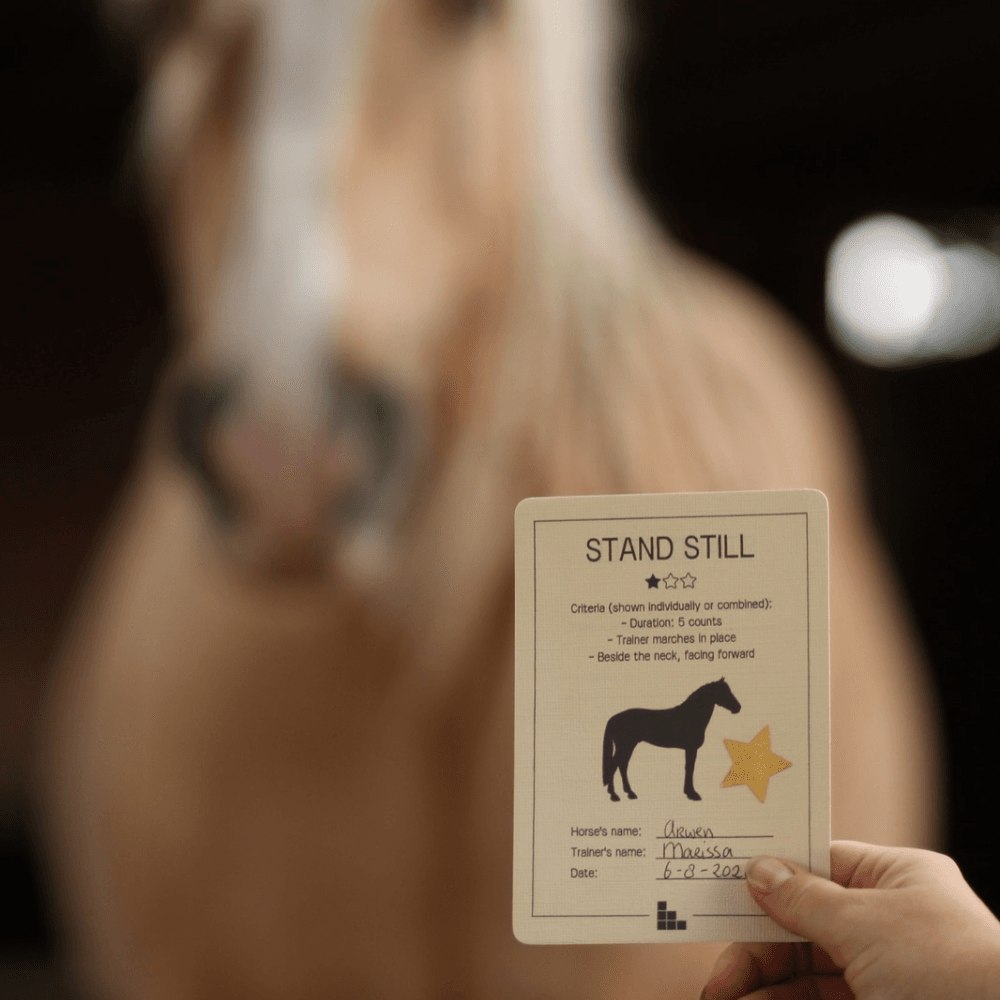
While browsing, a couple of Skillcards will probably catch your eye. Either because you know they’re important but you’ve been putting them off because they’re so daunting. Or maybe you’ve always wanted to try that exercise or procedure but had no idea where to even begin. Each card will show three levels (difficulty) or parts (different aspects), criteria (read more about those here) and requirements. You could simply check if an easier level or one of the requirement cards looks doable, and start with those! By the way: requirements are not mandatory.
Bottom up
R+ might be completely new to you or your horse, or maybe you just want to start over and go through “the steps” carefully and most of all thoroughly. I love that! In that case, here are some cards that A) you can definitely start with and B) will open up a lot of possibilities for you.
- Calm Eating (Desensitisation)
- (Re)connect (Foundation)
- Pause/Free time (Foundation)
- Nose Target (Foundation)
- Stand Still (Foundation)
- Feeding Techniques (Concepts)
My students often say how fun and rewarding it is to see everything come together almost automatically after going over the basics properly. Like Ken Ramirez said: Advanced training is just the basics done really, really, really well.
video coming soon

Getting started
My system is designed to eliminate the cognitive overload of juggling too many criteria at once, the frustration of vague goalposts, and the pressure of trying to figure out the ‘missing steps’ all by yourself. While every card connects to a larger framework of themes and goals, your only job in the arena is this single Skillcard you picked.
To ensure this remains practical (especially since you are likely training and filming alone) every card is stripped down to a maximum of three core criteria to remember. Provided you have completed the prerequisite cards, the gap between Level 1 and Level 2 is intentionally small and manageable.
A Skillcard outlines the final goal for that level; it is not your immediate assignment. You are not expected to achieve it in one session. If Level 1 is established but Level 2 feels out of reach, you build the behavior incrementally. You might adjust one specific criterion up to the Level 2 standard while keeping the other two easy. Once that feels solid, you isolate and upgrade the next criterion. Eventually, you combine them all, and the Level 2 goal is achieved.
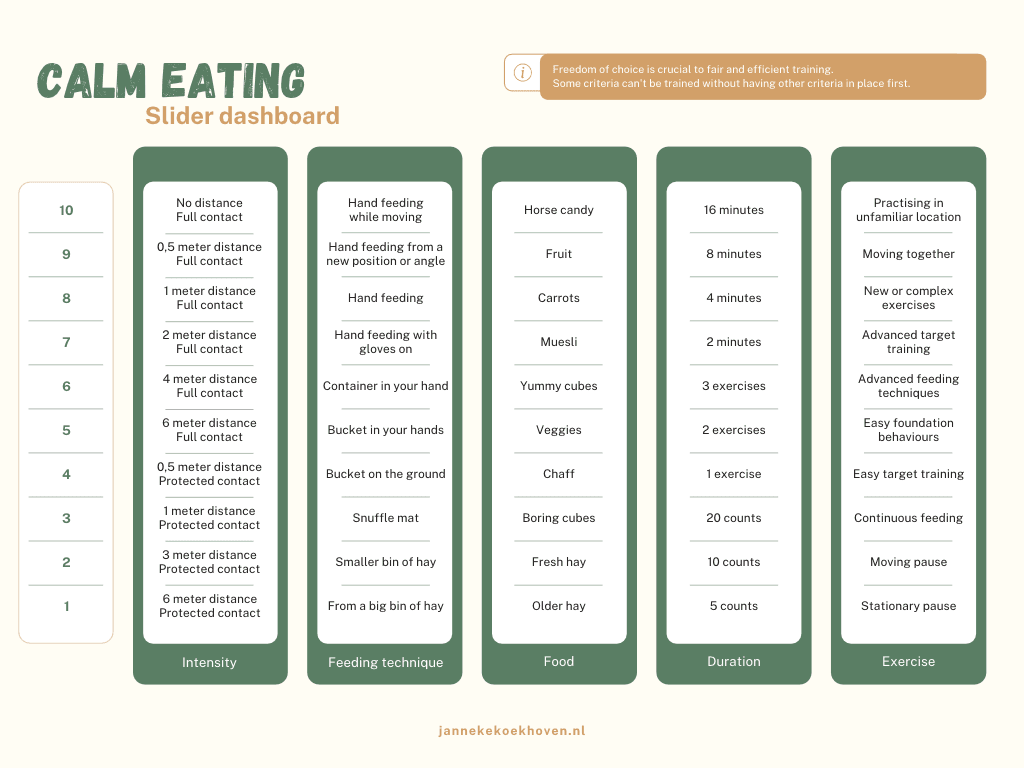
To help you navigate the spaces between levels, you can use a Criteria Slider Dashboard. At first glance, this tool contains a lot of data. It is important to know that it is not a mandatory to-do list. Instead, view it as a diagnostic control panel.
If an exercise falls apart, the dashboard helps you realize you exactly which “slider” (a specific criterion like duration, distance, or distraction) to turn down to help your horse succeed. If the exercise is too easy, it helps you decide which slider to push up.
You can find dashboards here.
For training tips go here or check the frequently asked questions.
When you are ready to submit a video for feedback, the rules of play are flexible and designed to fit your unique situation:
Demonstrate the card’s three criteria successfully to earn the Skillcard. You are allowed to perform and film these criteria separately to earn the card. Perform all three criteria simultaneously to earn Gold.
If drilling the basic Level 1 criteria would frustrate or bore your horse, you have the autonomy to perform them at a higher difficulty. For example, you can fulfill a Level 1 from a longer distance or with more duration. As long as the base requirements for Level 1 are met, you pass Level 1. (Note: Performing Level 1 criteria with extra difficulty does not automatically grant you Level 2.
I can help adapt the card to your team. If you or your horse face health, size, or mobility limitations, the criteria can be officially modified to suit your reality (for instance, substituting a physical requirement to accommodate a wheelchair).
Training tips
Prevent going too fast or too slow.
You want the right amount of repetition ánd momentum:
3 x quick, solid responses
= move to the next step! Remember to only increase one new criterion at a time. Check your slider dashboard!
2 slow or hesitant responses
= take a step back. Repeating will likely just give you more of the same.
Breaks and variety are almost always a good idea
Quit while you’re ahead, but don’t push to always end on a good note.
1 x undesirable behavior or emotion
= go back multiple steps. You’re training the horse of today, and they probably need your help.
Make sure your horse is ready solve a puzzle or say “Yes!” to a next step; make sure they are:
Able! Not too young, old, uncomfortable or tired
Bold! Not too overwhelmed, anxious, tense or scared
Savvy! Not confused, frustrated or unprepared
Keen! Not reluctant, coerced, bored or conflicted
Filming your training
Capturing your training on video is best way to train your eye and the only way to receive targeted feedback AND earn your Skillcards. The process is completely private because you simply upload your footage to a secure folder via your dashboard, with no need to post anything publicly.
The setup doesn’t require expensive equipment; a phone attached to a flexible tripod on a fence post or wheelbarrow works perfectly. Before you start, check your screen and pick visual markers (like a tree or a cone) so you know exactly where the camera’s frame ends. Both you and your horse must be clearly visible at all times, meaning no point-of-view (POV) footage. Ensure the light source is behind your camera, and keep the horse close enough to fill at least one-third of the screen. Because facial expressions are a critical part of assessing the horse’s emotional state, remove fly masks or grazing muzzles (unless the card explicitly requires them) and braid away heavy forelocks so the face is unobstructed.
Your submitted video must be between 30 seconds and two minutes long. This timeframe requires a bit of planning depending on the Skillcard you are working on. If the criteria only take 15 seconds to complete, you will need to perform multiple repetitions (ideally in different locations or on different sides of the horse) to meet the 30-second minimum and prove the behavior is reliable. If your footage is too long, you will need to trim out irrelevant breaks, edit out wandering off-camera, or speed up the “empty” moments to fit the two-minute limit.
Check out frequently asked questions about filming
Assessment
Once your video is securely uploaded, I review your session through a structured, supportive lens. You don’t just receive a quick grade; every feedback session includes a personalized video analysis of your footage, complemented by supplementary notes added directly to your Skillcard.
To give you clear, actionable guidance without overwhelming you, my review focuses carefully on five core areas:
Your horse's signals
Evaluating your horse’s subtle signals, facial expressions, and overall body language to ensure they are comfortable and emotionally regulated.
Agency and choice
Assessing your horse’s autonomy and the quality of the choices you are providing them during the exercise.
Skillcard criteria
Checking the actual behavior to ensure it aligns with the objective requirements defined on your specific card.
Behavioral reliability
I evaluate how robust the behavior is if you have shown the exercise across different locations or added variables.
Practitioner mechanics
I look at your timing, reinforcement delivery, physical posture, breathing, and overall attitude in the arena.
The feedback is designed to support your mechanical skills, validate your horse’s emotional experience, and elevate the entire conversation between the two of you. You’ll be able to access your feedback and see an overview of your submitted videos/earned Skillcards in your dashboard.
Frequently asked questions
Skillcards
I already know positive reinforcement theory. What does a 'Skillcard' actually add to that?
You might worry about getting just another theoretical explanation. Skillcards are different. I designed them as an objective recipe that translates theory into clear, measurable steps. They bridge the gap between knowing how something works and exactly knowing what to do, preventing you from getting stuck and keeping you and your horse motivated.
Does this work for a horse with severe trauma, or one that immediately says "no"?
Yes. My system is built around your horse’s autonomy. By breaking behaviors down into tiny micro-steps, a “no” from your horse stops being a dead end and becomes valuable information. It tells me exactly where you need to adjust the training to keep your horse feeling safe and confident.
Do I have to practice basic exercises for months, or can I start with my specific challenge (like hoof care)?
You can start right where you need help most. If the farrier is coming soon, you can use a “top-down” approach to look at your specific problem and see exactly which small foundational steps are missing. You do not have to spend months on arbitrary exercises; you can directly target the skills your horse needs right now.
Which tier fits me best if I only have one horse and train a few times a week?
If you are working with one horse and want steady progress with a helpful safety net, the “Active” tier is usually a good fit. It gives you clear structure and the monthly feedback you need to stay on track, without you paying for extra reviews you will not use.
Subscriptions
Why is this a monthly membership instead of a one-time course?
Because real-life training is an ongoing process, not a static event. A one-time course often leaves you stuck when things do not go exactly to plan. I set this membership up to evolve alongside your progress, giving you the continuous video feedback and support you need to keep moving forward.
What if I can't film my videos one month because of bad weather or a sick horse?
I know that life with horses is unpredictable, and sometimes a sick horse or weeks of bad weather get in the way. However, unused video credits do not roll over to the next month. I keep this monthly deadline in place because it actually helps you stay accountable and keeps your training momentum going! If your horse needs a longer break or circumstances make training impossible for a while, you always have the option to simply pause your subscription and pick it back up when you are both ready.
Can I cancel anytime?
If you opt for a quarterly or yearly subscription to take advantage of the discounted rate, you are committing to that specific timeframe and cannot cancel before that period is complete. Once your initial term is up, you will have full flexibility again.
Do I actually get physical cards sent to my home?
Yes, you do, provided you are on the Active, Extended, or Intensive plan! Because the cards represent real milestones, they are earned through the video feedback process. When you submit a video and I can see that you and your horse successfully meet a card’s criteria, I will send the physical version to your home to add to your portfolio. It is a nice, tangible reward that celebrates the actual progress you have made together.
Submitting videos
How does submitting videos work? Do I have to post them publicly on YouTube?
Not at all. I use a simple, private system. You just upload your short video to a secure folder so you don’t have to worry about technical headaches and privacy.
How should I record my training?
A Pivo or Pixio is fantastic, but you could simply mount your phone on a small flexible tripod which legs you could wrap around a fence, a tread-in post, the handle of a wheelbarrow, etc! Take a look at your phone to see what is in the frame and what is it, and mark it for yourself (either mentally like “from this tree to that tree” or physically by putting down some stuff so you know where to stop and turn around while training.
-
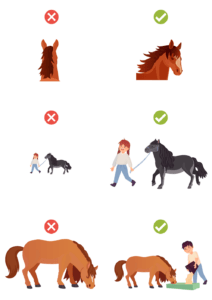
The horse’s face must be clearly visible, so film with the horse’s head facing the camera. Remove fly masks and grazing muzzles (unless they are required for that specific Skillcard). If the horse has a lot of hair, please braid (or plait) the forelock and, if necessary, the first 6 inches (15 cm) of the mane so it doesn’t obstruct the view.
-
I need to be able to evaluate the video properly, so make sure you aren’t filming from too far away. The horse should take up at least one-third of your camera or phone screen.
-
Ensure good lighting, especially for dark-colored horses. Tip: Position yourself so the sun or light source is (diagonally) behind the camera.
-
Both the handler/trainer and the horse must be clearly in the frame. Please do not submit POV (point-of-view) footage filmed by yourself while riding or training.
How long can the video be?
Minimum 30 seconds, maximum 2 minutes.
Is your video too long? (For example, due to breaks, or during exercises like Trimming or Staying in the trailer)
-
Speed up footage to 2x, 4x, or 10x speed.
-
Cut out irrelevant parts (breaks—unless it is a ‘Break’ card, of course—prolonged chewing or staring, the horse walking out of frame, etc.).
-
If you aren’t good at video editing, you can also provide timestamps. However, please note that there is a file size limit on the upload form.
Is your video too short? This probably means it’s a very short exercise, in which case you have an extra opportunity to demonstrate reliability.
-
Show the exercise a few times.
-
Show the exercise on different days or in different locations.
-
Show the exercise under different circumstances. This makes the behavior much stronger and greatly increases your chances of earning a gold star.
How long do I need to perform the exercise?
The required duration is usually listed in the criteria. If it isn’t listed, there may be a specified number of steps or meters, and the exercise lasts as long as it takes you and/or your horse to cover that distance. If no duration or distance is mentioned, show the exercise for 15 to 30 seconds.
How many times should I show an exercise?
Showing it once can be enough, but if you want to demonstrate the reliability of the behavior (and your cue) to ensure you get a gold star, you can show it 2 to 3 times. Ideally, do this in different locations or on the other side of the horse.
Can I click in between, or do all criteria need to be shown simultaneously/consecutively?
If you click in between or show the criteria separately, you are still eligible for a Skillcard. If you show everything all at once or consecutively for a single click and treat, you have a chance to earn a Skillcard with a gold star!
Exception: For hoof care, you do not have to do all 4 feet in a row, and certainly not for a single click. This is essentially four exercises in one.
Training
Why do some Skillcards have 3 parts and others 3 levels?
Some Skillcards come with three levels. Level 2 is usually more advanced than Level 1, and so on. In these cases, it’s often important to complete the previous level first.
Other Skillcards are split into parts, each covering different criteria. The order in which you complete these depends entirely on what your horse needs at that moment.
I don't know how to get started with my Skillcard...
That’s perfectly fine! You don’t have to execute the entire Skillcard perfectly right away. If anything is unclear, just send me a quick email. If you understand the exercise but are struggling to meet the criteria, just drop one or two criteria or lower the difficulty while you practice. In the Online Workshop, you can find examples of how to make criteria harder or easier in the criteria slider dashboards under Study Material.
What is the difference between a lure, a prompt, and a cue?
They are all antecedents: (combinations of) internal or external stimuli that can cause a behavior.
-
A lure is when you use food in your hand to position or move your horse. Example: You stand next to your horse and hold a treat out diagonally in front of you, causing your horse to make a transition from halt to walk.
-
A prompt is essentially a positive trigger: a lure, a fake lure, a feint, presenting a target, or using another cue; something that gets the horse moving (literally or figuratively) but which you will fade out later and replace with your chosen cue. Example: You stand next to your horse and reach your hand out (without food) diagonally in front of you (either briefly or a bit longer). This reminds your horse of the lure, prompting them to transition to the walk.
-
A cue is a signal that reliably triggers a behavior. It’s often a stimulus that previously had no meaning and therefore elicited no reaction from the horse, but now acts as a “green light” for a specific behavior, letting the horse know, “If I perform behavior X right now, I will get a click + treat.” Example: You stand next to your horse, adopt an active posture, and say “Walk!” (a word/action that previously had no meaning to the horse). The horse transitions from halt to walk.
You usually only introduce a cue once the behavior is already established. That way, you don’t associate your entire learning process or half-baked training attempts with your chosen “final cue.”
Sometimes, human and horse don’t entirely agree on what exactly the cue is for behavior X. You might think that lining up at the mounting block happens because of your hand signal, while your horse actually does it automatically as soon as anyone steps on the blue mounting block. Standing on the block is the cue in that case, not your hand signal.
To indicate a carefully chosen and human-trained cue, I sometimes use the term “final cue.”
A cue can consist of multiple stimuli (think of the mounting block + standing on it; just the mounting block without a person is not a green light to line up for a click + treat for our fictional demo horse in this scenario). We call this a compound cue.
There are many types of cues: tactile, auditory/verbal, visual/hand signals, objects, and contexts (location can be part of your cue). Technically, we could also use smells or tastes, but those are less practical.
A lure is almost always a prompt, but a prompt is not always a lure. A reliable cue is also a prompt, but a prompt is not always a reliable cue. There is some overlap, and sometimes you have to think about exactly what kind of “green light” trigger you’re dealing with. But in general: lure = guiding with food, prompt = “helpful trigger”, and a cue is ideally a human-taught signal (or combination of signals) that reliably results in a behavior.
What is the difference between groundwork and leading position?
I refer to different positions when it comes to groundwork:
-
Groundwork position (Face-to-face): You are walking backwards while your horse walks forward toward your chest.
-
Leading position: Side by side, just behind the horse’s eye, both facing the same direction.
-
In-hand position: At the girth/saddle area, both facing the same direction.
-
Longeing/Lunging position: About 3+ tracks further inside than your horse, parallel to the horse’s body, between the girth and the tail.
-
Long-lining position: Directly and diagonally behind your horse.
-
Driving position: Directly behind your horse.
Abbreviations you might see on the Skillcards:
-
FT1 – FT5 = Feeding Technique 1 through 5
-
HL = Horse length
-
SL = Stride length
-
WH = Height at the withers
-
SW = Shoulder width
-
CH = Chest height
-
RoR = Rate of Reinforcement
-
FW = Forwards
-
BW = Backwards
Is your abbreviation not listed? Just let me know!
What does "a short stop" mean?
You will mostly encounter this in the Transport Skillcards. It is completely okay if your horse takes a moment to quickly scan the environment before walking in (to the trailer). You can do a few things here:
-
Just let them look, take a look yourself, and take a deep breath out. They will often walk on after a second.
-
Is it taking longer? Target Party! Have your horse touch an easy (!) nose target 3 to 5 times without asking them to go any further into the trailer. Let them ground themselves and give them a confidence boost.
-
Is that not working? Then maybe take a step back (literally or figuratively), take a break, and perhaps revise your training plan.

Foundations

Desensitisation

Husbandry and medical care

Exercise

Transportation

Concepts
